
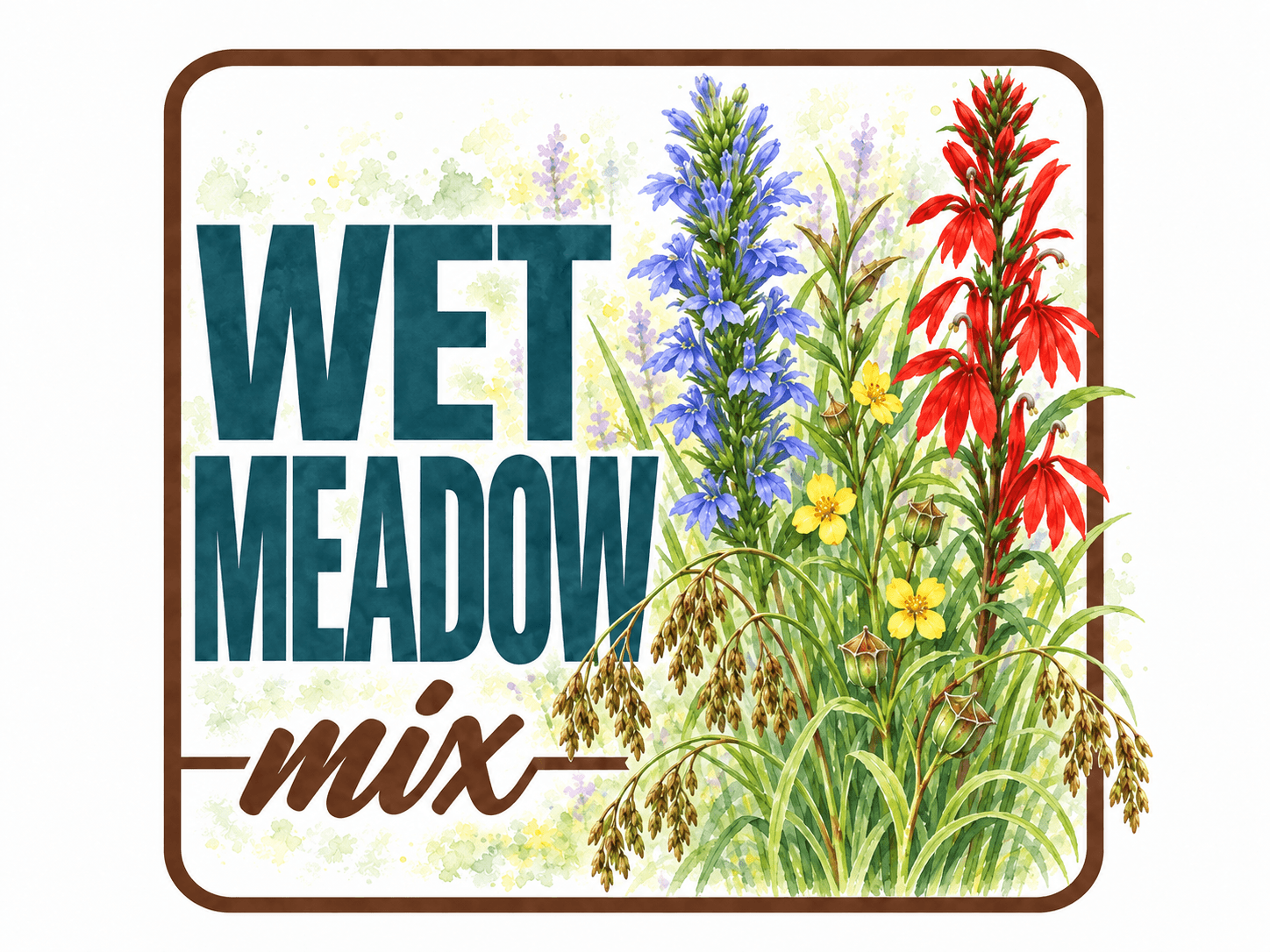

A diverse native meadow designed for wet soils that stay soggy longer than the surrounding ground, with changing blooms from spring through fall and vegetation that generally remains easy to see across.
Wet Meadow is for places such as swales, wet bottoms, drainage areas, low spots, seepy areas, wet portions of rain gardens and riparian areas with wet soil. It can tolerate temporary standing water for several days and occasionally longer, but it is not intended for permanent standing water or prolonged inundation.
Soils: Wet / seasonally soggy or saturated
Light: Full sun to part shade; tolerates up to approximately 65% shade
Typical appearance: Generally around waist high to somewhat taller, with some individual species exceeding that height
Bloom season: Spring through fall
Winter interest: Native grasses, sedges and other grass-like species provide structure, attractive seed heads and seasonal interest after the growing season
Diversity: 20+ wildflower species when wildflowers are included, plus 4+ grass or grass-like species when grasses are included
Wet Meadow is designed to establish a full stand. Choose the size of your planting area under Coverage and your wildflower-to-grass ratio under Mix Balance.
If you’re purchasing for cost-share programs, visit our Cost-Share Shop.
$20.00 – $4,058.00Price range: $20.00 through $4,058.00
Choose how much emphasis you would like to place on wildflowers or grasses. The Wildflower Dominant, Balanced and Grass Dominant options are all appropriate choices. The best option depends on the appearance, habitat and budget you have in mind.
A flower-heavy planting with enough native grass, sedges and other grass-like species to add structure, enhance wildlife and pollinator habitat, provide winter interest and help reduce weed pressure.
An even combination of wildflowers and grasses for a planting with a strong mix of seasonal color, structure, habitat value and winter interest.
A grass-heavy planting with a substantial wildflower component for seasonal color, pollinator value and diversity. This option may also be a good choice when erosion control or budget is a major concern.
The full Wet Meadow Wildflower Component without the wet-site Companion Grass Component. This option is especially useful when you want to overseed wildflowers into an established native grass or sedge planting or strengthen the wildflower component of an existing planting.
You can also order Only Wildflowers for an all-wildflower seeding if that is specifically what you want. However, we generally do not recommend an all-wildflower seeding for a new stand-alone planting. Including native grasses, sedges and other grass-like species usually provides better structure, stronger competition with weeds, additional habitat value and more winter interest.
The full wet-site Companion Grass Component without the Wet Meadow Wildflower Component. Choose this when you specifically want a grass- and sedge-based seeding, when you want to overseed into an established wildflower-only planting or when you want to strengthen the grass-like component of an existing native planting.
The percentages above show the estimated percentage of the stand represented by each component – in theory, the percentage of the ground covered by that component as the planting develops. They do not guarantee the exact percentage of mature ground cover. Soil, weather, management and individual species performance will influence how the planting develops over time.
This mix was designed with wildflower meadows in mind. Chosen for their ability to grow in damp and seepy areas that dry out only in the dry summer weather, these beautiful wet-loving wildflowers can be a great addition to wet parts of a raingarden or a naturally wet area; however, they do not like to be underwater for long periods of time. This mix can grow to about shoulder high and features changing blooms from spring to fall. Perennials, annuals, and biennials. Plant with Companion Grass Mix for wet areas. We recommend at least 25% grasses in a planting. Contains 20+ species of wildflowers. Annuals and biennials will bloom first, with perennials typically expressing themselves by year 3.
Wet Meadow is designed for wet soils that stay wet noticeably longer than the surrounding ground.
A practical way to think about a wet site is this: when the rest of the property is dry enough to drive across, this is the place that may still be too muddy. It may be the spot where you do not want to walk because you are likely to get your feet wet or your shoes stuck in the mud.
These sites may be seasonally soggy or saturated and can sometimes hold temporary standing water. Wet Meadow can tolerate water standing for several days and, occasionally, around a week depending on the plants and growing conditions.
It is not intended for permanent standing water or places that remain inundated for long periods of time.
Wet Meadow works well in places such as:
Pond edges deserve a little extra thought because several moisture zones can occur within just a few feet. The permanent-water zone is too wet for this mix. The wet-soil zone just above permanent water may be a good fit, while higher portions of the bank may grade into mesic or even dry conditions.
If the site is simply good, productive soil that drains normally after rain, Prairie Patchwork Meadow may be the better choice. Wet Meadow is for the places that stay wet after the rest of the land has dried out.
Wet Meadow is not normally a forage mix. It may occasionally have a place within livestock pasture, but its primary design goal is an attractive, diverse native meadow.
Wet Meadow can grow in full sun to part shade and can tolerate approximately 65% shade.
This makes moisture especially important when choosing between Wet Meadow and Shadows & Sunbeams Meadow. If a site is both genuinely wet and partly shaded, Wet Meadow may be the better fit because it is built around the wet-soil conditions.
Wet Meadow was designed first to make a beautiful native landscape on wet ground.
Its aesthetic design is based primarily on two things:
Wet soils can produce vigorous plant growth, so Wet Meadow may grow somewhat taller than Prairie Patchwork under favorable conditions. Some individual species may rise above waist height, but the planting as a whole is still intended to feel like a manageable meadow rather than a wall of vegetation.
We intentionally avoid building the mix around species that commonly reach 10 or 12 feet tall.
The appearance changes throughout the year.
Spring flowers give way to different summer blooms, followed by another palette in late summer and fall. There may be natural pauses between peak bloom periods, just as there are in native plant communities, but the goal is changing seasonal color rather than one short flush of flowers.
After flowering has finished, the grasses, sedges and other grass-like species continue contributing to the landscape. Their structure and attractive seed heads can add interest well beyond the growing season.
Although Wet Meadow was designed around landscaping and aesthetics, its diversity also makes it useful for pollinators, wildlife, restoration and erosion control.
The same flowers that provide color can provide nectar and pollen for bees, butterflies and other insects. Seeds, insects and vegetation provide food and habitat for wildlife. Deep-rooted perennial plants occupy the soil and provide lasting vegetation, making the mix useful in many restoration and erosion-control situations.
Wet sites can also be places where bare ground and moving water create erosion concerns. When erosion control is especially important, we generally recommend choosing either the Balanced or Grass Dominant version.
Wildlife and pollinators benefit from diverse plantings, and Wet Meadow is designed to provide that diversity while concentrating on species suited to wetter soils.
Wet Meadow is built around a full stand of perennial native plants, with annuals and biennials added for extra color and seasonal interest while the perennial community develops.
Annual and biennial species may bloom during the first or second growing season, while many of the longer-lived perennial species take more time to establish. Over time, the perennials become the long-term foundation of the meadow, allowing the planting to persist, reproduce and continue functioning for many years.
Wet Meadow is not simply a few wet-site species planted together.
When wildflowers are included, the Wildflower Component contains at least 20 species of native wildflowers. When grasses are included, the Companion Grass Component contains at least four native grasses, sedges or other grass-like species.
We intentionally combine plants with different sizes, rooting patterns, growing seasons, bloom periods and growth habits. A diverse community can make use of space in ways a monoculture cannot: smaller plants can occupy spaces around larger plants, species grow actively at different times of year, and plants use different portions of the soil profile.
We design this mix at a full seeding rate. Our goal is for the desirable native plants to eventually occupy the available growing space rather than intentionally leaving large openings between plants.
Some seedings are intentionally designed at partial rates so volunteer annual plants such as Ragweed, Foxtail and other annual vegetation have room to establish. That can serve certain specialized habitat or management goals, but it is not how we generally design HNO mixes, including our wildlife plantings. Most customers would rather have the species they planted filling the site than large openings occupied by volunteer weeds.
With this mix, we are aiming for a dense native plant community. If establishment goes well, as the planting matures – often around the third growing season and beyond – the desirable native plants should increasingly grow shoulder to shoulder. Fewer open spaces means fewer opportunities for unwanted annual weeds and invasive plants to establish.
A full seeding rate does not mean the planting will be weed-free. The existing soil seed bank will usually contain plenty of weed seed, and annual weeds can be especially noticeable during the first year while the slower native seedlings are establishing. The goal is that, over time, the desirable native plants occupy more of the available growing space and provide stronger competition.
The result is a planting designed as a plant community, not just a collection of seed.
The exact species and proportions in Wet Meadow may change from batch to batch depending on seed availability, seed source, crop conditions and the seed lots available when a batch is made.
Rather than defining Wet Meadow by one permanent recipe, we build each batch to meet the same overall design goals: a diverse collection of native species adapted to wet soils, with seasonal interest and a strong perennial foundation.
Species commonly used in the Wet Meadow Wildflower Component include White Beardtongue, Sweet Black-Eyed Susan, Brown-Eyed Susan, Bunchflower, Culver’s Root, Blue Lobelia, Cardinal Flower, Swamp Milkweed, Allegheny Monkey Flower, Seed Box, Ohio Spiderwort, Tickseed Sunflower, False Aster and Sneezeweed.
The wet-site Companion Grass Component commonly includes River Oats, Nodding Bulrush, Hop Sedge, Beaked Panic Grass and Frank’s Sedge.
Exact contents vary by batch. The seed tag supplied with your order lists the actual species in the mix you receive.
If the inclusion – or exclusion – of a particular species is important to your project, contact HNO before ordering and we can tell you what is in the current batch.
Wet Meadow is your base mix – a complete planting designed for the site conditions described above. Enhancements allow you to add extra emphasis to additional goals without having to design a custom mix from scratch.
Choose your base mix for your site conditions, then choose enhancements for the additional goals that matter to you. Enhancements are selected for those goals rather than for a particular soil type.
You may select more than one enhancement.
Adds wildflowers selected especially for their value to butterflies, native bees, hummingbirds and other pollinators. Some species may grow taller than the typical Wet Meadow planting.
Adds species selected for their value to birds through seed, insects, habitat structure or other wildlife benefits. Some species may grow taller than the typical Wet Meadow planting.
Adds flowering species selected especially for their attractiveness and usefulness to honey bees. Some species may grow taller than the typical Wet Meadow planting.
Adds native plants with known edible uses, including species with traditional food uses and plants featured in HNO’s edible native plant resources and recipes. Some species may grow taller than the typical Wet Meadow planting.
Adds desirable native species selected for strong competition in established native plantings where weed pressure is a concern. Some species may grow taller than the typical Wet Meadow planting.
This enhancement is intended to strengthen desirable native plant competition. It is not a substitute for appropriate weed management.
Some enhancements consist primarily or entirely of wildflowers. If you select Only Grasses as your base mix and then add a wildflower enhancement, your finished planting will contain the grasses and grass-like species plus the wildflowers included in that enhancement.
A native wildflower meadow develops differently than an annual flower garden.
Year 1: Much of the activity is happening close to the ground and below it. Annuals or biennials may provide some early flowers, but many perennial native plants are still putting energy into roots and establishment. Also, during this first growing season, if annual weeds are severe competition with the young seedlings, mowing high can be a helpful weed control tool; to learn more about it, check out our First-Year Mowing Guide.
Year 2: You should be able to see the perennial plants more clearly, especially if you know what to look for. There may still be annual and biennial blooms, depending on how those species develop and the conditions during the first two growing seasons.
Year 3 and beyond: Perennial blooms often begin to appear around the third year, although this is not guaranteed. Establishment depends on weather, weed pressure, soil conditions, management and other factors. As the perennial plants mature, they increasingly form the long-term character of the meadow. After this third growing season, you can also begin to use controlled burns to manage and invigorate the native plants.
A first-year native planting can look surprisingly weedy while the slower-growing native seedlings establish. Don’t judge the long-term success of the meadow by whether it looks like a mature wildflower planting during its first summer.
Good establishment starts before the seed is planted.
The basic goals are a clean, firm seedbed and good seed-to-soil contact. Existing vegetation should be adequately controlled before the native seedlings emerge. It is also important that the seed reaches the soil rather than getting caught in dead plant material, tree leaves or other surface debris.
Native wildflower and grass seed should be planted shallowly. The goal is seed-to-soil contact – not burying the seed deeply. In most situations, seed should be no deeper than approximately 1/8 to 1/4 inch, and some seed remaining visible on the soil surface is perfectly acceptable.
Winter is generally the preferred time to plant Wet Meadow. Many of the wildflowers and some of the grasses require a period of cold, moist conditions to break seed dormancy. Planting during winter allows the weather to provide this cold-moist stratification naturally.
Wet sites create an additional practical consideration: when can you actually get onto the site? If you are using a tractor, drill or other equipment, it often makes sense either to seed early in the dormant season while the ground is still dry enough to support the machinery, or to wait until the ground is frozen so equipment can travel across the site without getting stuck or causing excessive disturbance.
If the area is small enough to seed by hand, wet ground is less of a limitation because heavy equipment is not required.
Cold-moist stratification can also be done artificially in a refrigerator. See HNO’s Cold Moist Stratification Guide for instructions. Wet Meadow can be planted in spring without artificial stratification, but lower germination – especially among the wildflowers – should be expected.
Wet Meadow may be broadcast by hand or planted with a drill or broadcast equipment capable of handling fluffy native seeds, depending on the size and condition of the site.
For detailed instructions, use HNO’s Establishment Timelines, Seedbed Preparation Guides and Seeding Method Guides to develop a plan for your particular site. Our New Dirt Work Establishment Plan also includes guidance for establishing native vegetation where topsoil has been removed or soil conditions have been substantially altered.
Wet Meadow is intended primarily for the tallgrass prairie region and the tallgrass savannas and woodlands of the East.
It is generally appropriate across much of the central and eastern United States, from the central Great Plains eastward and from the upper Midwest south toward the Gulf Coast, where local soil, rainfall and climate are reasonably similar to the conditions described for this mix.
It is not intended as a shortgrass-prairie mix for the dry Great Plains farther west, and it should not be treated as a Florida-specific mix. If you are outside the general region described above, contact us before ordering. We may be able to recommend Wet Meadow, suggest another mix or help you find a regionally appropriate option.
Wet soil stays noticeably wetter for longer than ordinary garden or cropland soil.
Think of the spot that is still muddy after the rest of the property has dried enough to drive across. It may stay soggy, saturated or soft underfoot for extended periods.
If the ground simply remains wet for a day or two after rain and then behaves like ordinary productive soil, it may be better described as mesic and may fit Prairie Patchwork Meadow instead.
Yes, temporarily.
Different species tolerate inundation differently, but the mix can generally handle standing water for several days and occasionally around a week.
It is not designed for permanent standing water or places that remain inundated for long periods.
The main difference is site conditions.
Dry ‘n Rocky Meadow is designed for dry to dry-mesic soils in full sun.
Prairie Patchwork Meadow is designed for mesic or average-moisture soils in full sun.
Wet Meadow is designed for wet, seasonally soggy or saturated soils and can also tolerate substantial partial shade.
Shadows & Sunbeams Meadow is designed primarily around part-shade conditions where the soil is not extremely wet or extremely dry.
On a site that is both genuinely wet and partly shaded, Wet Meadow may be the better choice because the wet-soil conditions become the more important limitation.
Sometimes.
A pond edge can contain several different soil-moisture zones within a short distance.
The permanent-water zone is too wet for Wet Meadow. The wet-soil zone just above permanent water may be an excellent fit. Higher on the bank, conditions may become mesic or even dry – especially on a pond dam or where exposed clay dries hard.
Choose the mix based on how that particular portion of the pond edge behaves rather than assuming the entire pond perimeter has the same soil moisture.
Yes. Swales, drainage areas, wet bottoms, low spots and seepy areas are some of the kinds of sites Wet Meadow is designed for, provided they do not remain under permanent standing water.
Yes, particularly in the wetter portion of a rain garden where water collects temporarily but does not remain standing for long periods.
Different portions of a rain garden may have different moisture conditions, so another mix may be better on the drier edges.
Yes. Wet Meadow tolerates approximately 65% shade.
If the site is genuinely wet, Wet Meadow may be preferable to Shadows & Sunbeams even when partial shade is present.
Wet Meadow is intended to remain a manageable meadow that you can generally see across.
Many plants will be around waist high, while some species may grow taller – especially in rich, wet soils and during wet growing seasons.
The mix intentionally avoids the very tall 10- to 12-foot species that would make the planting feel like a wall of vegetation.
Enhancements may also introduce taller species.
The goal is changing bloom from spring through fall, but a native meadow does not produce exactly the same amount of color every week. Different species take turns flowering, creating a changing seasonal palette with occasional natural lulls between peak bloom periods.
Yes. Its diversity and long bloom season make it useful for pollinators. Customers who want to put even more emphasis on that goal can add the Pollinator Enhancement.
Yes. Native wildflowers, grasses, sedges and the insects associated with them provide food and habitat for many kinds of wildlife.
Choose the option that best matches the planting you have in mind.
If you really want a wildflower planting, choose Wildflower Dominant. If you want a grass- and sedge-heavy planting with wildflowers mixed in, choose Grass Dominant. If you want a nice mix of both, choose Balanced.
The wildflower component is more expensive than the grass component, so if budget is a concern, you may also want to choose a version with less wildflower seed, such as the Balanced or Grass Dominant option.
Grasses, sedges and other grass-like species occupy spaces between wildflowers, add structure, enhance wildlife and pollinator habitat, provide fall and winter interest, help reduce weed pressure and provide fuel if prescribed fire eventually becomes part of the management plan.
Yes. Choose Only Wildflowers under Mix Balance. This option is especially useful for overseeding wildflowers into an established native grass or sedge planting, strengthening the wildflower component of an existing planting or creating an all-wildflower seeding.
An all-wildflower seeding is generally not our recommended choice for a new stand-alone planting because grasses and sedges provide important structure, habitat, winter interest and competition with weeds.
Yes. Choose Only Grasses. This option is useful for an all-grass/sedge seeding, overseeding into an established wildflower-only planting or strengthening the grass-like component of an existing native planting.
Yes. You may combine multiple enhancements if several goals are important to you.
The species listed on this page are examples of plants commonly included in Wet Meadow. Exact contents can change between batches.
The seed tag supplied with your order identifies the actual contents of the batch you receive. If a particular species is especially important – or if there is a species you do not want – contact us before ordering to ask about the current batch.
Choose the Coverage that fits your project and use Quantity for multiples. For example, a 2,000 sq ft project can be ordered by selecting 1,000 sq ft and a quantity of 2.
If you’re not sure how many square feet or acres you have – especially with an irregularly shaped planting area – contact us and we can help estimate the area and determine how much seed you need.
Planning a larger project? Contact us before ordering. Larger quantities may qualify for additional quantity discounts.
Choosing native seed is easier when you match the plants to the site.
If you’re not sure whether your site is wet enough for Wet Meadow, whether another meadow would be a better fit, which Mix Balance to choose or which enhancements make sense for your goals, contact Hamilton Native Outpost. We are happy to help you think through the planting.
Wet Meadow Mix
| Weight | N/A |
|---|---|
| Light | Full Sun to Part Shade |
| Soils | Wet |
| Height | 12"-60" |
| Bloom Month | May, Jun, Jul, Aug, Sep, Oct |
| Specialty Uses | Butterfly, Wildlife, Landscaping |
| Planting Season | Dormant / Spring |



Pure Live Seed (PLS) is the portion of good viable seed per pound. It is a measure of the seed that is alive and able to sprout into plants. This product is sold by PLS ounce/pound. To provide one ounce/pound of viable seed, you will receive more than one ounce/pound of product. Read more about PLS here.