
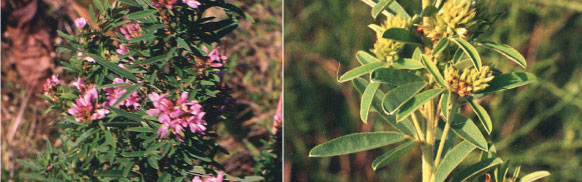
Slender Lespedeza and Roundhead Lespedeza (also called Bush Clovers), Lespedeza virginica and Lespedeza capitata, are both native lespedezas. Both are great for wildlife. The seeds are consumed by various birds including Mourning Dove, Bobwhite Quail, Wild Turkey, and Slate-Colored Juncos. The flowers are visited by a variety of native bee species as well as some butterflies. The plants are high in protein and eaten by many herbivores both wild (e.g. deer, rabbits, groundhogs) and domestic (e.g. cattle, goats). Lespedezas are also legumes; legumes have a unique involvement with certain bacteria in the soil. The plant feeds the bacteria and in turn the bacteria take nitrogen from the air that is inaccessible to plants and give it to the plant. In the long-run, this adds nitrogen to the soil and acts as fertilizer to other plants. Interestingly, Slender Lespedeza is also being used in cancer-treatment research. Other good guy lespedezas can also be found in native grasslands including Trailing Lespedeza (Lespedeza procumbens), Hairy Lespedeza (Lespedeza hirta), and Violet Lespedeza (Lespedeza violacea).
Sericea Lespedeza, which goes by aliases of Chinese Bush Clover, Silky Bush Clover, and Lespedeza cuneata was introduced into the United States from east Asia. It has been planted for erosion control, livestock forage, and wildlife cover. When the plant was introduced, the diseases and insects that once kept it in check were left in Asia. As a result, it has become very competitive in grasslands and even been declared a noxious weed in Kansas.


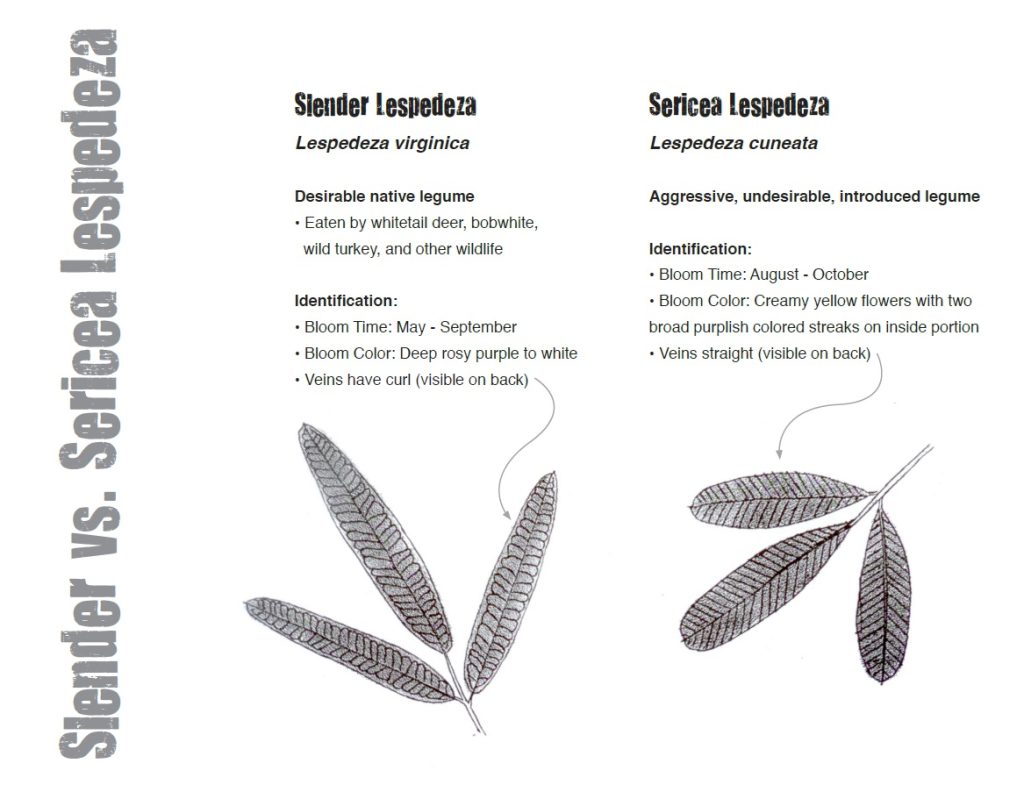
The ugly part of this story is that the bad guy, Sericea, tries to pass itself off as one of the native lespedezas, Slender. To the untrained eye, the form of the two plants is often very similar being tall and skinny with small leaves. Sometimes late in the season the form of the two plants will vary with Sericea being bushier, but there are two other characteristics that are very helpful in distinguishing the good from the bad. One is bloom color, which is obviously only useful for a small portion of the summer while the plants bloom. The other is the appearance of the veins in the leaf which is best seen on the back of the leaf or when held up to the sky.



5 Responses
Thanks for this great short super helpful article. I am now able – sadly – to confirm that the lespedeza spreading through an abandoned farm field adjacent to our woods is indeed the non-native. The field is re-wilding with many valuable native trees and flowers but also many invasives such as Autumn Olive, Amur honeysuckle, Tree of Heaven, lespedeza, etc. The other half of the 116 acre property is part of forested hilly ~ 500 acre stream valley. Needless to say the area is a valuable environment for birds, foxes, coyotes, tortoises, snakes, etc etc.
Thank you for your comment!
Ms. Thomas, this plant is very useful. I am researching epoxy, and the sericea lespedeza is mentioned as one of the plant sources for condensed tannins, which also expel parasites from grazing animals. Apparently, too much causes cattle and sheep to bloat because of protein binding. Where is this useful farm? Have a nice day!
BUT! Easy to pull, especially spring or after rain. Go out there with a pitchfork and light bag, and rip out what you can in flower, especially before setting seed. GREAT to take out your aggression for anything political or emotional!
Thank you for your comment! Good stress relief.