Join our Pasture Walk February 19, 2026. You can RSVP here.
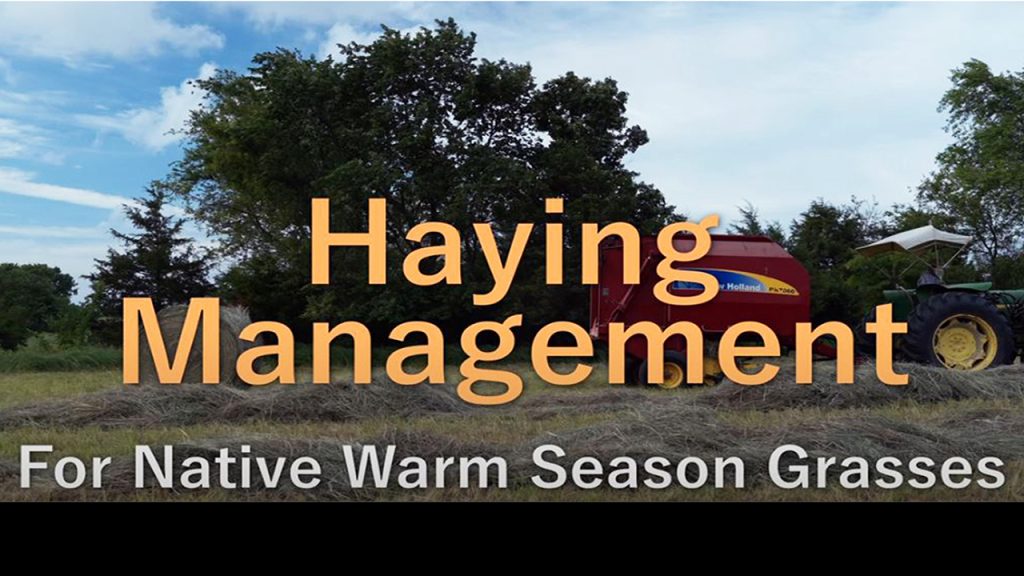
Haying Management

Haying Native Warm Season Grasses | NWSG Management Series

Haying Management for Native Warm Season Grasses Field Guide

This is a set of notes to take to the field when haying Native Warm Season Grasses (NWSG). Other videos in this series discuss grazing NWSG as well as fertilizing, burning, and more.

Cutting Height

  • Ideal cutting height is 8 inches.  Many folks see the 8” of stem as “hay that should’ve been in the bale.”  However, leaving this bottom 8” promotes faster regrowth of the grass, which can begin within 2-3 days after cutting, because it protects the growing point.  There is no statistical loss of hay yield by cutting high, and the hay quality is improved.  The tall stubble also elevates the hay which creates better drying conditions.
  • How do I set my equipment to cut at 8 inches?  Common ways to adjust to this taller cutting height are:  1) cylinder stops or stroke limiting cylinders  2) shoes that go on the edge of the mower to elevate the cutting bar  3) tilt the cutting bar to make small adjustments.  For more details, consult the owner’s manual of your equipment.

Timing

  • Cut when drying conditions are good.  Naturally, NWSG hay is cut in the summer when the temperatures are warm and rain is less likely to interrupt. 
  • Curing time can be as little as 24 hours.  Good summer drying weather combined with the taller stubble suspends the hay off the ground can make for ideal curing.
  • Cut in the boot stage.   Cutting in the boot stage (before seedheads are showing) usually balances the quantity and quality.  Higher quality hay can be achieved with earlier cuttings but the tonnage will not be as high while a later cutting will yield the quantity but the quality will be markedly less. 
  • First cutting dates.    The date for the first cutting varies depending on your location (both latitude and altitude).  In the Mid-South, the suggested first cutting dates for various NWSG are as follows (as shown by Patrick Keyser in, Native Grass Forages for the Eastern U.S.)
    • Eastern Gamagrass                                                                            May 20-25Switchgrass                                                                                       May 25-June 1Big &/or Little Bluestem  (or mixes dominated by these species)             June 20-25       
    • Indiangrass (or mixes dominated by this species)                                   June 30-July 5
  • Don’t cut for 8 weeks before average date of first frost.  The NWSG needs time to store energy for winter.  As such, it is best management practice to not cut the grass between 8 weeks before frost and the first hard frost, which is when the grass goes dormant.  After the grass is dormant, the brown growth can be hayed (the quality is low at this time of year), grazed, or burned.

Frequency – How many times in a year can NWSG be cut per year?

  • How to improve the likelihood of multiple cuttings per year.  Factors within your control that can help the NWSG to regrow quickly and be cut multiple times a year include:  1) don’t wait too late for the first cutting  2) remove the haybales from the field as soon as possible and as efficiently as possible to minimize the impact of the equipment traffic on the regrowth  3) cut 8+ inches high.
  • Number of cuttings per year varies by NWSG species.  The number of cuttings per year in the Mid-South, assuming a proper cutting height of 8 inches or taller, according to Native Grass Forages for the Eastern U.S. by Patrick Keyser, is (keep in mind that this will need adjustment for areas farther north and higher altitudes):
    • Eastern Gama Grass                                                    2 (and in some cases 3)Switchgrass                                                                2
    • Big &/or Little Bluestem &/or Indiangrass                       2 (but forego the 2nd harvest every few yrs)
  • Many producers, however, choose to cut only once each year to minimize cost  and maximize yield per cutting.  So, try something, experiment, and see what works for you.

Signs of Stand Weakening. 

If you suspect that a stand is weakening, make management changes.  Often, foregoing the 2nd cutting in a year is a wonderful rest for the plants.  Keep in mind that cutting more often doesn’t result in greater yields over the life of the stand, because if the stand is weakening, that means less future production (and the same harvest expenses).  Signs that a stand is weakening include:

  • Larger plant spacing on a mature stand or stand thinning.
  • Reduction in the number of tillers per plant.
  • More weed pressure.
  • Trend toward lower yields.  Hay yield can vary based on many factors, but if the overall, multiyear trend is decreasing, this can be associated with weakened plants.

Forage Testing.  

Traditional forage tests of NWSG are usually not predictive of animal performance.  Keep the following in mind:

  • If NWSG are cut when in the boot (no visible seedheads) and put up well (for example, it doesn’t get rained on when it is down), the quality is good to excellent.
  • These same grasses can put 2 lbs/hd/day average daily gain (ranging from 4 lbs early in the season to 1 lb later in the season).  Well put-up hay is of similar quality.
  • Traditional lab tests don’t reflect the quality of NWSG  hay because the nutrients are more readily available in warm season grasses than cool season grasses. 
  • The “stemmy” appearance of NWSG hay in the bale, if put up well, is actually the rolled leaves rather than stems.

Share this!

Leave a Reply

Your email address will not be published. Required fields are marked *

Receive monthly emails with our latest native plant articles and videos.

newsletter icon, Hamilton Native Outpost